
A woman on Threads posted something that stopped me in my tracks.
She said she was 49-51, had seen "the most rapid decline in her appearance ever"—grey hair, wrinkles, the whole midlife inventory—and despite doing botox, filler, and hair dye, she was exhausted by the effort and the money. She wanted to know: how do you get comfortable with aging and losing your looks?
1.2K likes. 2.7K comments. Because of course.
I replied honestly: I decentered men and the male gaze. I went to therapy. I worked on feeling good from the inside. I realized that how I look is the least interesting thing about me.
And then came the response that I knew was coming, that always comes: Ok, but you look great. So it's easy for you to say that.
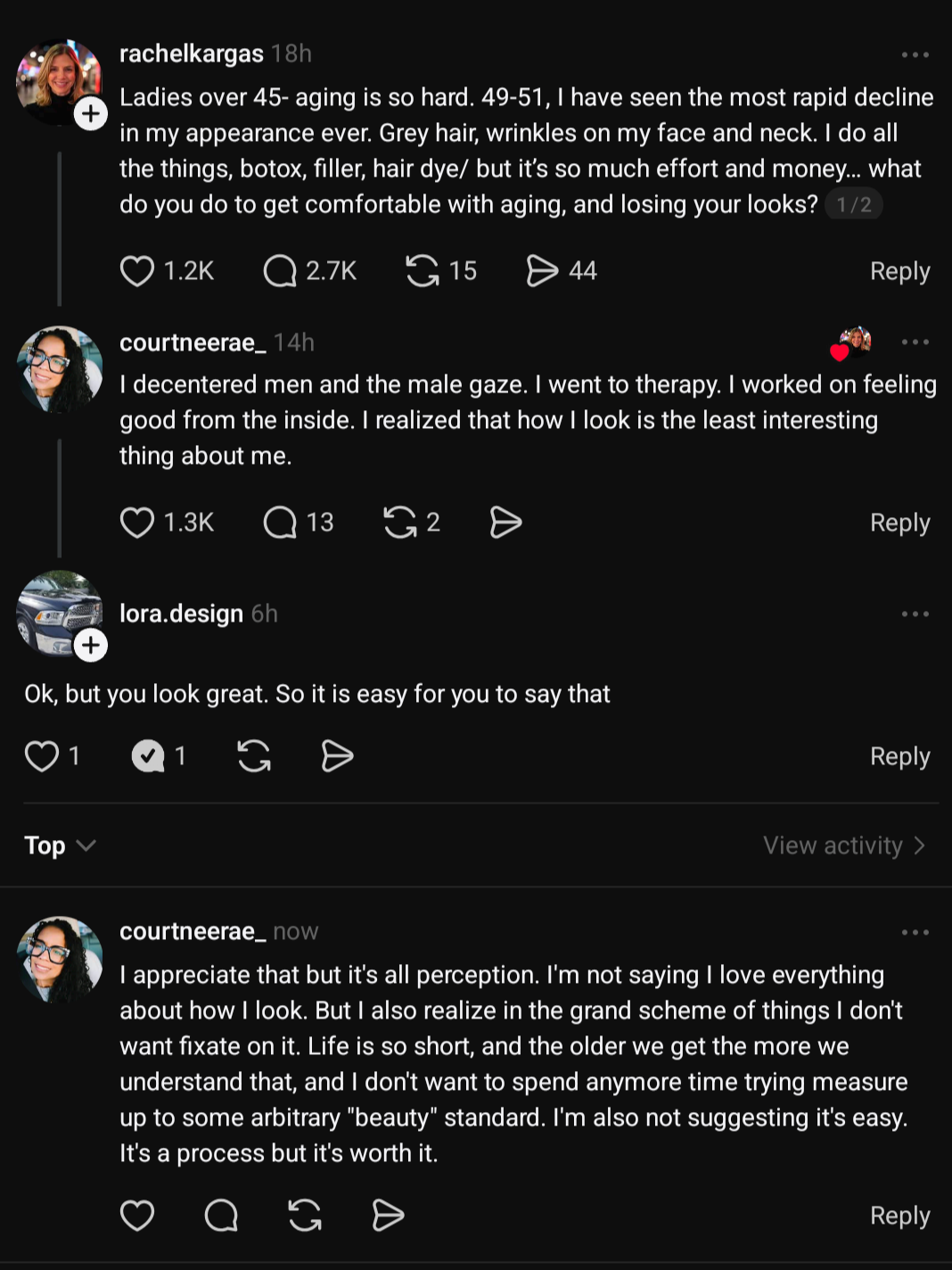
I want to sit with that for a minute. Because that well-intentioned reply contains the problem.
When someone says "it's easy for you because you look great," they are, without realizing it, confirming that their sense of self-worth is still entirely contingent on how they appear to an outside observer. They're saying: I would stop caring about my looks too, but only once I'd already secured approval for them.
That's not freedom. That's just winning the game before you quit it.
And here's what I want to say clearly: I'm not saying I love everything about how I look. I don't. The mirror shows me things I don't always love. But I've stopped treating those things as emergencies. I've stopped treating my face as a problem to be managed and my body as a project to be completed before I'm allowed to feel good about myself.
That shift didn't come from confidence. It came from asking a question I'd never asked before: Who was I being beautiful for?
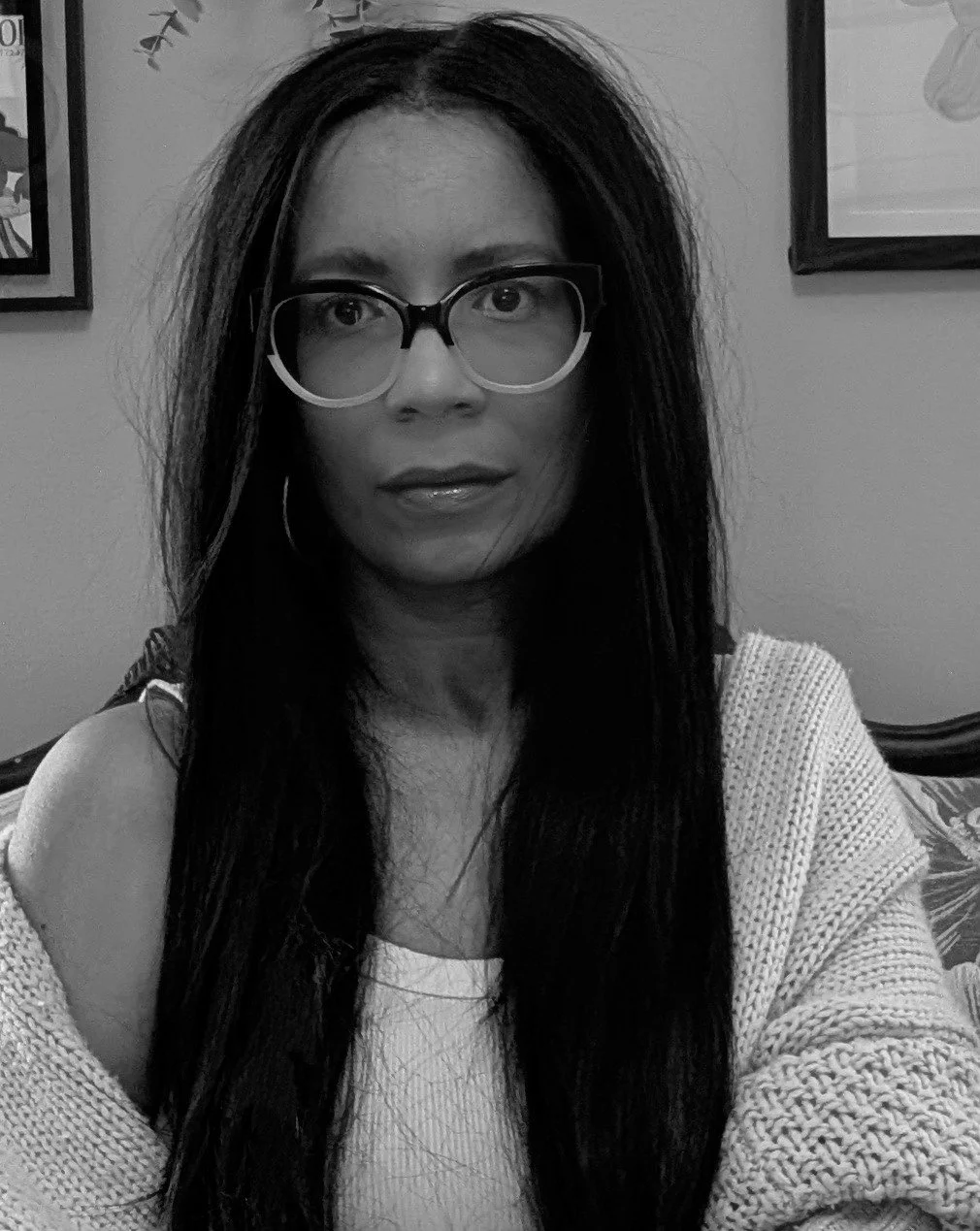
The answer to that question is uncomfortable as hell.
We're living through a moment that is forcing a lot of uncomfortable clarity. The release of the Epstein files and the slow, sickening drip of names and details, is shining a light on something women have known in our bones forever but have rarely been allowed to say plainly:
The beauty standards we were handed were not designed for us.
They were not designed to make us feel powerful, healthy, or like ourselves. They were designed by industries run by men, marketed through a male gaze, and reenforced through the social punishment of women who didn't comply. The goal is to keep us as close as possible to an adolescent ideal. Small. Smooth. Unlined. Pre-experienced. Unthreatening.
The "decline" that women describe when they talk about aging? The grey hair, the wrinkles, the changing body? Those aren't actually a decline. They're evidence of a life. They're what a woman looks like when she has survived, accumulated wisdom, raised children, built things, lost things, and kept going.
The reason they feel like a decline is because we have been taught to measure ourselves against a standard that was never about celebrating womanhood. It was about approximating youth. And we now have more evidence than ever about exactly what kind of men were invested in that standard, and why.
"Decenter the male gaze" sounds like a bumper sticker or a bold proclamation on a graphic t-shirt until you actually try to do it.
It starts with noticing. Just noticing.
When you feel bad about your grey hair—who told you grey was bad? Who profits from you dyeing it? When you're considering a procedure—is it because you want something, or because you've absorbed the message that your natural face is a failure? When you're getting dressed—are you dressing for yourself, for the day you're actually having, or are you performing femininity for an imaginary audience?
I'm not saying don't dye your hair. I'm not saying don't get botox. I dye my hair. I wear extentions, braids, wigs. I wear makeup. I love fashion with my whole heart. But I've tried to get rigorous about the difference between things I do because they bring me genuine joy versus things I do because I'm afraid of what happens if I stop.
Therapy helped me see that most of my anxieties about appearance were actually anxieties about being abandoned. About becoming invisible. About taking up space without permission. About being found unacceptable. Those are not beauty problems. Those are wounds that no amount of filler can touch.
I want to tell you something personal here, because I think it matters.
I struggled with an eating disorder for almost two decades.
I know what it is to loathe yourself so completely that you punish your body physically. I know what it is to wake up every morning and have the first thought—before coffee, before your children, before any awareness of the actual day in front of you—be about your body and how wrong it is. I know what it is to let that hatred organize your entire life: what you'll eat, where you'll go, what you'll wear, what you'll try, who you'll let close, what you'll dare to want.
I am not writing this from a place of judgment. I am writing it from a place of grief.
Because when I look back now, I don't just see the physical toll. I see all the other things. I see the experiences I didn't let myself have because I was convinced I was too fat, too ugly, too unacceptable to deserve them. I see the joy I left on the table. The trips I avoided. The pictures I hid from. The rooms I didn't walk into. The versions of myself I didn't let out.
I think about all that time. All that mental energy. The hours and days and years I spent in a war with my own body—and I ask myself: What else could I have done with that? What could I have built? What could I have learned? What could I have felt?
And honestly? It makes me sad.
Not in a way that's meant to spiral into more self-criticism—I'm done with that particular loop. But in the way that you grieve any real loss. Because it was a loss. It was years of my life organized around hatred of myself, and I will never get those years back.
Here's what I want you to hear: that self-hatred didn't come from nowhere. It was cultivated. It was fed and reinforced by every magazine, every diet culture message, every subtle and not-so-subtle signal that a woman's worth is located in how closely her body approximates an ideal that—as we are now more clearly than ever being shown—was never designed with our flourishing in mind.
The eating disorder was my body internalizing a message that had been delivered to me ten thousand times before I even had the language to question it.
And if I had gotten even some of those years back—even some of that mental space—I cannot imagine what I might have done with it.
That's what's really at stake here. Not just self-acceptance as a feel-good concept. But the actual hours of your actual life.
Here's what I know now that I didn't know at 18, 28, or even 38: the older we get, the less time we have. And somehow that makes things clearer.
I don't want to spend the years I have left trying to measure up to a standard designed by people who do not have my best interests at heart. I don't want to look back at my fifties—which I now understand are not a consolation prize but an actual destination—and realize I spent them in a war with my own face.
Women in midlife become more interesting, more complex, more capable, more themselves. The grey hair is real. The wrinkles are real. The changing body is real. And so is the radical liberation available to us if we're willing to ask the hard question: What would I look like if I were doing this for me?
That's not an easy question. The process of answering it isn't easy either. I went to therapy. I did real work. I'm still doing it.
But I promise you: it is worth it. Not because you'll stop noticing the changes, but because you'll stop treating your own reflection like an enemy.
I meant when I said it on Threads.
How you look is the least interesting thing about you.
Not because appearances don't matter. Not because beauty isn't real and joyful and worth celebrating. But because you have accumulated a life. You have a mind shaped by decades of experience. You have survived things. You have opinions that were hard-won. You know things that took years to learn. You have relationships, memories, work, art, loss, love.
And you have been so busy worrying about your wrinkles that you may have forgotten how incredible all of that is.
The beauty standards we were handed were designed to distract us from exactly that. From our own power. From our own authority. From the sheer irreversibility of what we've become.
Age on your own terms. That's the revolution.